
St. George's University School of Medicine Graduate Helps Perform World-First Robotic Heart Procedure in Outpatient Facility
Last Update: Monday, August 15, 2022 : 15:42 (+4GMT)
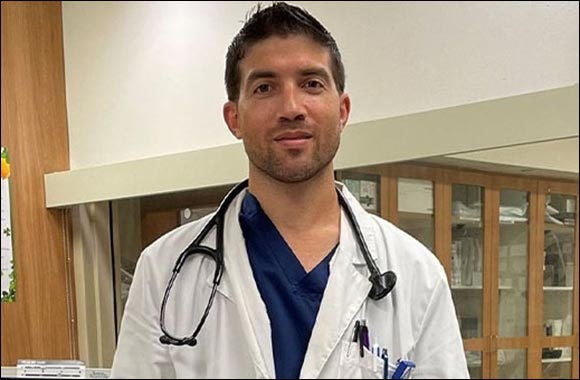
Dr. Adam Bierzynski was on the team that performed the first-ever outpatient robotic percutaneous coronary intervention. He reveals why the procedure was groundbreaking, the potential life-saving capabilities of robotics within the field of cardiology, his experience at St. George’s University, and how his medical training set him up for success.
“I wanted to be a doctor for most of my life,” says Dr. Adam Bierzynski, alumni of St. George’s University (SGU), School of medicine in Grenada.
“My grandfather was the chief medical officer of Grenada for a time, and I was always interested in the sciences and being able to apply knowledge to helping and healing,” he adds.
After being raised and completing high school in Grenada, in the Carribean, he started the 4-Year Medical Degree Program at SGU in 2007 – a time he remembers fondly.
“Attending SGU was a fantastic experience. The campus is uniquely breath-taking in its location. Coupled with a diverse student body and accessible faculty, I can truly say that I thoroughly enjoyed my time at SGU and would recommend it to anyone considering applying,” he says.
After graduating SGU in 2011, he started his internship and residency in internal medicine at Lenox Hill Hospital in Manhattan. “I was accepted into the general cardiology fellowship program at Lenox Hill Hospital Heart and Vascular, then did a further subspecialty in interventional cardiology at the same institution, completing my long haul of training in June 2018.”
Since then, Dr. Bierzynski has been busy pioneering at the cutting-edge of medical science, making waves in a very specialist field: interventional cardiology through the use of robotics in outpatient settings.
In 2020, he was among the team who performed the first-ever outpatient robotic percutaneous coronary intervention (PCI) at an ambulatory surgery center.
“The coronary arteries supply blood to the heart muscle. A ‘heart attack’ is when those arteries are blocked and blood flow to the heart muscle stops and that muscle dies,” explains Dr. Bierzynski.
“A PCI is the placement of a stent into the coronary artery that opens the blockage and allows for blood to flow through the artery once again. Typically, this is done in a hospital and the performing doctor is standing at the operating table wearing heavy lead shielding to protect from radiation that is used to perform the imaging.”
What’s different about a robotic PCI is that he uses a mechanical arm that advances the wires, balloons, and stents during the procedure in order to open the blocked arteries. This allows him to sit in the adjacent control room and control the robot to perform the procedure instead of having to stand at the procedure table next to the radiation generator. This has only ever been done inside a hospital until recently.
Dr. Bierzynski was part of the team that performed the first ever robotic PCI in an ambulatory outpatient facility. “Fortunately, that first procedure couldn’t have gone better, and the patient was discharged home hours later,” he says.
“I have continued to perform this procedure robotically whenever feasible, and it’s likely that robotic PCI will become more and more commonplace and performing it in the outpatient setting will also become routine.
“This was a timely innovation during the pandemic. By performing it as an outpatient at a surgical center, patients could be assured that there were no COVID patients at the facility so that they were at minimal risk. This was important as people were postponing life-saving care, especially early on in the pandemic, due to their desire to avoid exposure to a potentially life-threatening disease. Also, it allowed the performing doctor to minimize his exposure to the patient as well.”, he adds.
“Although it will always be awesome for me to look back and think, ‘but I did it first!’”




- Five ways Emirates is helping customers travel with greater confidence... [1962-Views]
- H.H. Sheikh Ammar bin Humaid Al Nuaimi chairs Ajman Bank Board Meeting... [1790-Views]
- Spain Defeats Argentina to Claim Second FIFA World Cup Title... [1689-Views]
- MS Dhoni Joins Malabar Gold & Diamonds as Brand Ambassador, Strengthening the ... [1302-Views]
- UAE International Investment Council Holds Second Board Meeting, Appointing Ke... [1220-Views]
- Dubai celebrates residents as destination's most powerful advocates through ne... [1201-Views]
- The Festival of Diamonds Returns: Tanishq Unveils Over 10,000 Natural Diamond ... [983-Views]
- Dubai's off-plan market raises the bar for next-generation landmark luxury dev... [969-Views]
- Fertiglobe More Than Doubles Adjusted EBITDA in Q2 2026, Proposes H1 2026 Divi... [967-Views]
- e& UAE leads industry transition to 5G-native IoT with successful testing of R... [951-Views]
- 10th Al Dhaid Date Festival draws large crowds, celebrating the UAE's rich agr... [913-Views]
- How to Choose the Right Medical Insurance in Dubai Based On Your Lifestyle?... [908-Views]
- e& UAE activates the highest 5.5G modulation (1024QAM) on its live network — a... [903-Views]
- Record Profits Driven by Resilience, Sustainable Growth and a Fortress Balance... [892-Views]
- A Benchmark of Trust: The UAE Good Delivery List and the Standard Emirates Gol... [885-Views]
- Al Masaood Automobiles Achieves Highest-Ever Score in Nissan's Global Dealersh... [861-Views]
- Al Masaood CVE Set to Go to UD Trucks Extra Mile Challenge Global Finale in Ja... [849-Views]
- UAE National Team steps up preparations for Jiu-Jitsu World Championship in Ab... [807-Views]
- Sensational Tadej Pogačar Claims Fifth Tour de France Title in Seven Year... [790-Views]
- UAE Jiu-Jitsu National Team crowned Asian champions, winning 55 medals across ... [782-Views]
