
QUEENS OF TIME BOGHOSSÍAN HIGH JEWELLERY COLLECTION
Last Update: Wednesday, September 2, 2026 : 10:21 (+4GMT)
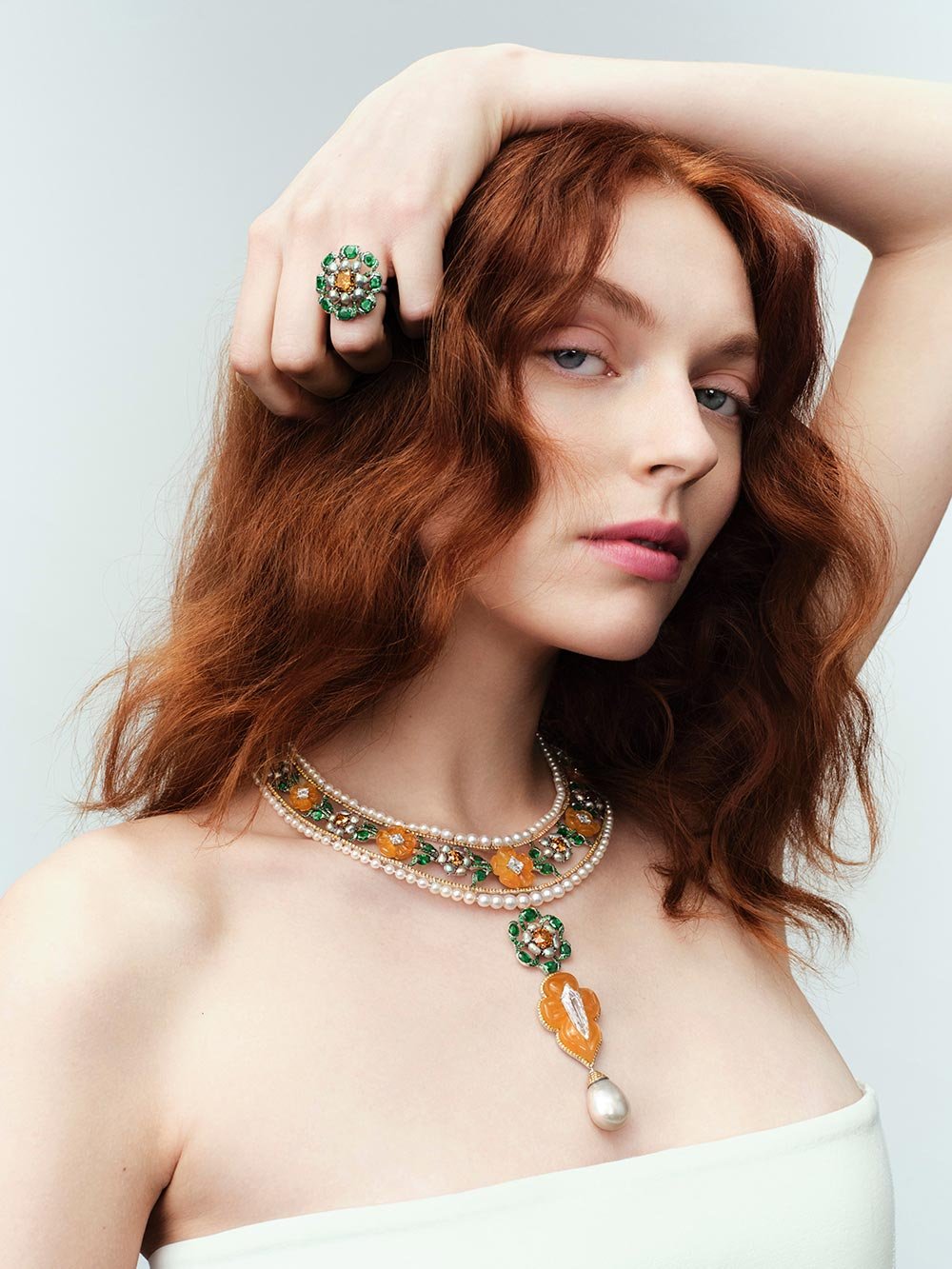
Boghossian’s Queens of Time is a high jewellery collection like no other. Taking inspiration from the lives of eleven formidable queens who changed history by ruling over kingdoms often resistant to their power, they had to fight every day of their reigns to achieve their political goals. In doing so they transformed the culture, society and mindsets of those around them and Boghossian has created 39 magnificent jewels utilising new techniques, motifs, symbolism and gemstones to honour their legacy.
These queens are muses for the vision of Boghossian’s CEO Albert Boghossian and Creative Director Edmond Chin, celebrating the strength, courage and style of real women using jewellery as a timeless, universal language. This is a more personal and emotional collection, following on from the architectural splendour of Palace Voyages in 2024.
From Ancient Egypt, where Queen Cleopatra’s legendary love of emeralds rivalled her extravagant taste in gold during the 1st century BC, to the Achaemenid Queen Atossa in the 5th century BC, who stacked bracelets riotously carved with mythical creatures in densely colourful gemstones; jewellery charted their rise to power in all its glory. Queen Seondeok of Silla favoured such a cacophony of jade beads, golden leaves, hanging fish and bird-shaped charms in 7th century Korea that an exalted type of musicality entered the room before she did. They simply bedazzled everyone around them, and all these queens had one thing in common that reinforced their status and sovereignty with beauty and purpose: jewellery.
QUEEN MÃYÃDEVI
c. 6th century BC – Shãkya Kingdom, Nepal/ India
Mãyãdevi was Queen of the Śãkya, an Indo-Aryan society in Southern Nepal and Northern India at the foot of the Himalayas. Her life may have passed as a simple passage in history were it not for a dream she had one moonlit night: four spirits carried her to Lake Anotatta, bathed and adorned her in heavenly garments, before a white elephant holding a lotus entered her womb. She gave birth painlessly under a flowering sal tree in Lumbini in 563 BC to Siddhãrtha Gautama, who would become the Buddha. Seven days later, Mãyãdevi passed away and was reborn in heaven, her story forever linked to one of the world’s most profound spiritual legacies.
Boghossian has long been inspired by the miracles and mysteries of India. The Maison presents a dramatic set in a cacophony of blues, drawing on this rich source of inspiration. Lapis lazuli evokes a mysterious blue, paraiba the colour of heaven, white diamonds the lotus flower, and spessartite garnet a vibrant contrast. Floral elements echo the sal tree under which Mãyãdevi gave birth, reflecting her enduring symbolic presence.
QUEEN ATOSSA SHAHBANU
c. 550-475 BC – Achaemenid Empire, Persia
Atossa Shahbanu was the first Queen Mother of the Persian Empire and, as daughter of Cyrus the Great and wife of Darius the Great, she was a powerful woman. She commanded the resources of the empire as her own and strengthened her influence over domestic policy when her son Xerxes became king. As the great- great-granddaughter of Teispus, founder of the Achaemenid Persian dynasty, her authority was unassailable, and she wielded it with a steady, astute hand. Greatly admired and respected, she was described as having the light of the Gods in her eyes, her regal and dignified bearing becoming legendary, in an empire renowned for its delicate gold granulation and elegant repoussé work, at the forefront of luxury.
Boghossian presents a bracelet, ring and earrings recalling the colour palette Atossa relished. Lapis, aquamarine, imperial morganite, pink tourmaline, carnelian and diamonds are set into white and rose gold evoking sacred geometry.
Inspired by historic Achaemenid silver bowls with buds and petals, the composition reflects her opulent world and Boghossian’s pursuit of universal beauty.
QUEEN CLEOPATRA VII
69-30 BC – Ptolemaic Kingdom, Egypt
Cleopatra VII was a gifted scholar, philosopher and scientist who spoke nine languages, ruled over 7 million people, making her one of the richest people on earth. Raised at the royal court of Alexandria as heir to the Ptolemaic Kingdom, she ascended the throne in 51 BC at the age of 18, co-regent alongside her brother and husband. In her fight for Egyptian independence against the ruthless Roman Empire, Julius Caesar and Mark Antony became infatuated with her and she bore them four children. Considering herself the reincarnation of the goddess Isis, Cleopatra adorned herself in gold and precious gems, using jewellery as a powerful expression of sovereignty and influence.
Boghossian, inspired by her flair for the dramatic and her love of pearls, has created a grand golden yellow mother-of-pearl necklace set with an extraordinary light yellow lozenge diamond. Eighteen yellow Asscher-cut diamonds undulate at its centre as it curves around the neck in a striking homage to her Greco-Egyptian style, and thick, glossy diamond-twisted mother-of-pearl strands form a Hercules Knot, symbol of love, protection and healing. Using the colour gold rather than gold itself adds depth, while a striking ring in the same style completes the set.
QUEEN THEODORA OF BYZANTIUM
c. 500 – 548 AD – Byzantine Empire
Theodora grew up in Constantinople, city of the Eastern Roman Empire and later met Justinian, nephew of Emperor Justin I and they fell in love. When he ascended to the throne, she became Empress, advising him on matters of state with a strategic brilliance that astonished those around her. Together they built the Hagia Sophia and created ‘Justinian’s Code’, a set of reforms that allowed women to ask for divorce, which formed the basis of much of European law and reflected her enduring influence. Theodora’s love of gold was typical during the Byzantine era, but her obsession with pearls and flawless gemstones speaks to an innate sophistication that catapulted her to greatness.
Boghossian’s buttery gold necklace, set with blue sapphires, emeralds, spinels and natural saltwater pearls, features three spectacular pendants suspended from a choker, inspired by her life and style. Rough diamonds bring “a touch of light” to modern granulation, and “there are echoes of antiquity throughout this queenly piece,” observes Creative Director Edmond Chin. Mismatched chandelier earrings, a signature Boghossian does so well, add drama, while the interplay of techniques, colours and textures connects ancient worlds to the present with regal charm.
QUEEN SEONDEOK OF SILLA
595–647 AD – Kingdom of Silla, Korea
Queen Seondeok was the 27th monarch and first female ruler of modern-day Korea. During her reign, she expressed her love of astronomy, while her devotion to spirituality led to temples and monasteries dedicated to Buddhism. Her tactical prowess established diplomatic relations with the Imperial Tang Dynasty in China, fostering a cultural renaissance that improved conditions for the poor and education for the masses, laying the groundwork for the unification of Korea. She could be seen wearing a tree- shaped crown with antlers from which dangled decorative gold discs and jade ornaments, symbolising the Tree of Life and the union between the divine, heaven and her realm on earth.
Drawing on the symbolism of her crown and her adornments, Boghossian evolves this idea into double cuffs, choosing jadeite, one of the most precious materials in Korea, as a foundation to set a series of glittering fancy vivid yellow diamonds. Jadeite branches converge around a central Type A pear cabochon on each cuff. Bell-shaped matching earrings with articulated yellow pear drops reflect a stateliness and grandeur worthy of nobility.
QUEEN ELEANOR OF AQUITAINE
1122–1204 AD – Kingdoms of France & England
Going from Duchess of Aquitaine in Southwestern France to Queen of France through her marriage to King Louis VII, Eleanor combined beauty with a sharp tactical brain. She later married the Duke of Normandy, who became King Henry II, becoming the only woman to have been both Queen consort of England and France. After a revolt against Henry in 1173, she was captured and imprisoned for 16 years. Freed in 1189, she ruled while her son Richard I fought in the Crusades. Formidable and enigmatic, she let her jewellery do the talking. She wore a golden crown with gem-encrusted circlets over a soft linen veil, chandelier earrings, and cascading pearl necklaces, favouring a French style considered unceremoniously lavish.
Boghossian draws inspiration from medieval books with raised gemstones set upon sheet gold to create a unique textured pattern for this suite of jewels. The radiant choker, earrings and ring set with very light yellow pear-shaped diamonds, are accented by vibrant orange sapphires and natural saltwater keshi pearls. Micro-set and box-mounted with flexible panels, the technically complex design layers colour, texture and light, while an abstract cross subtly recalls medieval motifs.
QUEEN INDRADEVI
c. 12th century AD – Khmer Empire, Cambodia
Indradevi was a pious, principled woman and queen of the Khmer Empire, which at its peak included Cambodia, Thailand, Laos and Vietnam in the 12th century. She hailed from the Kshatriyas, the warrior ruling class, yet was a devout Buddhist. After the early death of her sister, wife of Jayavarman VII, Indradevi became queen consort and used her power to champion Mahãyãna Buddhism, building temples and prioritising education, healthcare and equality. Highly creative, she became the earliest known female poet in Cambodia. At court, adorned in cross-body jewels, which flowed down from an intricate collar, fanning out from under her décolletage and around her hips before peeping out beneath fragrant jasmine garlands, alongside golden rings and a tiered crown, she appeared unmistakably queen.
Two suites of jewellery have been created, capturing the duality and beauty of sisterhood, of morning and evening in luminous shades of soft blues and greens, inspired by the serene grace of temple sculptures depicting Indradevi and her sister.
The first luminous set glows in pear-shaped mint tourmalines, unfolding alongside chrysoprase and aquamarines. Diamond baguette accents add sparkle and rhythm, completing this tribute to Indradevi’s poetic spirit and enduring legacy.
The second features oval-shaped and lily cut diamonds separating spectacular Paraibas, complemented by emerald- cut tanzanites, accents of hauyne, lapis and turquoise, and diamond-set paisley motifs inspired by an ornate belt she wore immortalised in stone on an ancient statue. “The colouration to me is a little bit like Cambodia during the monsoon rains,” says Edmond Chin. “It has that feeling of freshness in new growth.”
QUEEN ELIZABETH I
1533 – 1603 AD – Kingdom of England
Two years after Elizabeth was born at Greenwich Palace to King Henry VIII and Anne Boleyn, her mother was beheaded and she was declared illegitimate. In 1547 her father died and she eventually succeeded her half-sister Mary to the crown. Charismatic and determined, she took to the throne with gusto. As queen she established a moderate Church of England and defeated the Spanish Armada, ushering in a golden age of trade, exploration and the arts. Elizabeth’s status as an unmarried queen inspired her jewellery collection, with pearls symbolising purity. Aware of her image, she used style as a powerful statement.
Boghossian has created two sets of jewels in her honour, both containing pearls and much inspired by the lavishness of her gowns.
The first is a majestic sautoir led by an exceptional natural conch pearl. Strands of coral and spinel beads intertwine with coral and ruby cabochons and vibrant spinels, while antique gold beads lend refinement and radiance to the composition.
In the second, specially carved Tudor roses in agate contrast with vibrant green tsavorites and the grey-green shimmer of eighty-seven abalone pearls, as the beautiful surround to orangy diamonds.
A large natural saltwater pearl sways at the tip of the necklace with smaller natural saltwater pearls constructed as a frame throughout the piece. The composition is further enriched by the harmonious arrangement of all stones, together referencing the rich embroidered tapestries of the time.
QUEEN MUMTAZ MAHAL
1593 –1631 AD – Mughal Empire, India
Mumtaz Mahal married Shah Jahan at 19 and became his favourite wife. Her name, meaning ‘Exalted One of the Palace’, reflected her intelligence and influence. Fluent in several languages, she wielded considerable political power behind the scenes, subtly guiding his decisions at court. They lived in unparalleled luxury in the Agra Fort, an entire city behind high walls built in the Persian, Indian and Islamic styles with intricate stone inlay. Grand necklaces were part of her daily wardrobe including a gift from her husband of a family heirloom called the ‘Taj Mahal’ – an enormous heart-shaped, table-cut diamond set into grey jadeite and surrounded by red spinels and diamonds.
A masterful necklace by Boghossian containing white jade, jasper, agate, Zambian emeralds carved in Jaipur and tawiz-shaped diamonds and accompanied by a magical pair of mismatched earrings has been created in honour of Mumtaz. The tawiz-cut refers to the shape of a traditional pendant or locket worn as an amulet for protection.
In a second suite with a sculptural bangle at its centre, inlay from the palace is represented by pear-shaped emeralds set into soft white mother-of-pearl. Edged dramatically in pink spinel and tsavorite, it also has earrings and a ring to complete the set echoing the extravagance of her life. “Mumtaz lives on eternally, as was intended through the beauty of the Taj Mahal,” Edmond Chin.
QUEEN CATHERINE THE GREAT
1729 –1796 AD – Russian Empire
Catherine the Great ruled for thirty-four years as Empress of Russia, enjoying the longest reign of any female ruler in Russian history. She strategically married her cousin Peter and converted to the Russian Orthodox Church, changing her name from Sophia to Catherine, but he died in mysterious circumstances eight days after Catherine deposed him in a coup. Between her military campaigns against the Ottoman, Turkish and Persian Empires, she became a huge patron of the arts, founding The Hermitage Museum in St Petersburg, while the ‘Brilliant Room’ at the Winter Palace famously housed the Orlov Diamond, a 189.62 carat Golconda given to her by Count Grigory Orlov. Modernising Russian culture, she embraced the Enlightenment, giving women access to education, important jobs and unprecedented property rights, shaping the nation.
“My interpretation for Catherine is white on white, the cold glitter of Russian winters,” says Edmond Chin. Inspired by a rare bowknot diamond necklace commissioned by her and long hidden in the Kremlin, his abstract asymmetrical creation pairs faceted hexagonal moonstones with sharp kite shaped diamonds through the art of inlay. A natural saltwater pearl and hexagonal diamond bring flamboyance, which could have nestled nicely within the ‘’Brilliant Room’’ at the Winter Palace.
QUEEN JOSÉPHINE
1763 –1814 AD – First French Empire
Marie-Josèphe Rose Tascher de La Pagerie was born in Martinique in 1763 to a noble French family. She married Alexandre de Beauharnais, but during the Reign of Terror they were arrested and he was guillotined while she miraculously survived. In 1796 she married an utterly infatuated Napoleon Bonaparte, changing her name from Rose to Joséphine at his request, becoming first Empress of France and bringing harmony between the ostracised aristocracy and the new military elites at court. As leading patron of the arts, she supported painters, sculptors and jewellers, diffusing Napoleon’s harshness with a soft power that shaped society and diplomacy. Joséphine set a new standard of elegance, favouring sweeping diamond tiaras, neoclassical cameo parures and rows of endless pearls.
Inspired by her refined taste, Boghossian presents an ensemble carved entirely from morganite, set with sunset tourmaline and imperial topaz in soft blush tones, in reference to the name she used in her childhood. Architectural lines drawn from her Empire throne and the romance of Napoleon’s letters infuse the set with both strength and femininity.





- From a Pair of Shoes to a New Dubai Property: British Expat Wins Through ‘Win ... [2812-Views]
- Five ways Emirates is helping customers travel with greater confidence... [2124-Views]
- Sheikh Zayed Falcon Release Programme releases 2,400+ falcons in the wild sinc... [1656-Views]
- e& UAE launches Business Pro AI bundled with Microsoft Copilot at no additiona... [1262-Views]
- DSS FINAL SALE BRINGS UP TO 90% OFF ACROSS MORE THAN 500 BRANDS FOR THE FINAL ... [1252-Views]
- e& UAE leads industry transition to 5G-native IoT with successful testing of R... [1131-Views]
- How to Choose the Right Medical Insurance in Dubai Based On Your Lifestyle?... [1073-Views]
- Held under the patronage of His Highness Sheikh Hamdan bin Zayed Al Nahyan Ab... [1031-Views]
- Beautyworld Dubai's 30th Edition Brings Global BeautyIcons Together This Octob... [1013-Views]
- Tadej Pogacar Chases Tour de France–Vuelta a Espana Double... [981-Views]
- To enhance quality of sports services Ministry of Sports organises the first ... [893-Views]
- Dubai Summer Surprises Launches First Back-To-School Carnival at Palm Jumeirah... [853-Views]
- LG EMPOWERS DESIGNERS AND VIDEOGRAPHERS WITH NEW ULTRAFINE EVO 6K MONITOR... [807-Views]
- The Fellowship Just Got a Glam Upgrade with SHEGLAM X The Lord of the Rings™... [800-Views]
- Best Recruitment Agencies in Dubai and Executive Search Firms in the UAE in 20... [739-Views]
- RTA Hosts Microsoft Copilot Day to Enhance Employee Efficiency and Accelerate ... [731-Views]
- ORA Land Launches BluBay with Suryakumar Yadav as Brand Ambassador, Reinforcin... [713-Views]
- Your Guide to Winning Big This Summer Through Dubai Summer Surprises... [656-Views]
- Isaac del Toro lands overall title at the Lidl Deutschland Tour... [649-Views]
- EDGE Debuts Multi-Domain Defence Capabilities at DALO Industry Days 2026... [646-Views]
