
Samsung's EYELIKE™ Fundus Camera Repurposes Galaxy Smartphones to Improve Access to Eye Care
Last Update: Tuesday, May 4, 2021 : 14:23 (+4GMT)
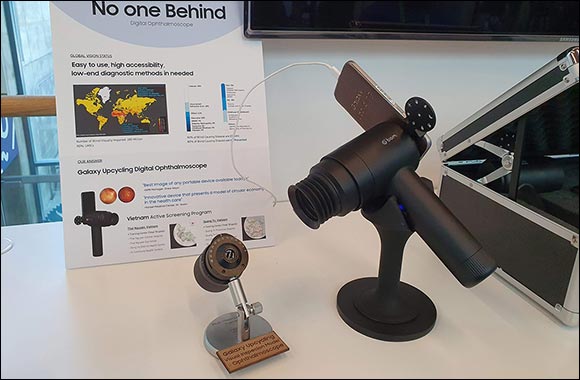
The Galaxy Upcycling program repurposes older smartphones into medical diagnosis cameras, helping underserved populations in Vietnam, India, Morocco and Papua New Guinea
May 4, 2021 – Samsung Electronics is repurposing older smartphones to enable greater access to ophthalmic health care in underserved communities around the world. Samsung partnered with the International Agency for the Prevention of Blindness (IAPB) and Yonsei University Health System (YUHS) in Korea to create medical devices that screen for eye disease by upcycling Galaxy smartphones that are no longer of use. This Galaxy Upcycling program is helping to address approximately 1 billion global cases of vision impairment that are preventable with proper diagnosis.
According to the World Health Organization (WHO), at least 2.2 billion people have a form of vision impairment and almost half of these cases were preventable or have yet to be addressed. There is a large disparity in the prevalence of vision impairment depending on the affordability and availability of eye care services. This is estimated to be four times more common in low- and middle-income regions as compared to high-income regions. .
“People around the globe face barriers to accessing fundamental health care, and we saw an opportunity to engineer smart, innovative solutions that reuse products to drive more sustainable practices and make a positive impact in our communities,” said Sung-Koo Kim, VP of Sustainability Management Office, Mobile Communications Business at Samsung Electronics. “This program embodies Samsung’s belief that technology can enrich people’s lives and help us build a more equitable and sustainable future for all.”
In 2017, Samsung created the Galaxy Upcycling program to introduce innovative ways that Galaxy devices can make a positive impact. Through the program, an older Galaxy smartphone can become the brain of the EYELIKE™ handheld fundus camera, which connects to a lens attachment for enhanced fundus diagnosis, while the smartphone is used to capture images. The Galaxy device then utilizes an artificial intelligence algorithm to analyze and diagnose the images for ophthalmic diseases, and connects to an app that accurately captures patient data and suggests a treatment regimen at a fraction of the cost of commercial instruments. The unique and affordable diagnosis camera can screen patients for conditions that may lead to blindness, including diabetic retinopathy, glaucoma, and age-related macular degeneration.
“We were looking for an eye health diagnosis solution that was cost-effective to reach as many people as possible, and when we saw the performance of Samsung’s Galaxy smartphones, we wanted to integrate their upcycling efforts into our research,” said Dr. Sangchul Yoon of Yonsei University Health System. “The combination of using multiple optical technologies and artificial intelligence, coupled with camera performance of a Galaxy smartphone, created an affordable medical device that was just as capable as a fundus camera used by medical professionals. This not only solved a health issue, but a growing environmental concern as well.”
Since 2018, Samsung has partnered with IAPB and Yonsei University Health System to benefit the lives and vision of more than 19,000 residents in Vietnam with its portable retinal camera. In 2019 alone, it supplied 90 portable ophthalmoscopes to health professionals operating in remote regions of the country without access to walk-in clinics. Now, Samsung has expanded the program to India, Morocco and Papua New Guinea. Samsung is also broadening its capabilities to new screening areas, including using upcycled Galaxy devices to create smartphone-based portable colposcopes to screen for cervical cancer and improve women’s accessibility to quality health care.
“As the world slowly recovers from the COVID-19 pandemic, it is more evident than ever that technology can be deployed as an eye health solution. In the countries where the EYELIKE Platform is trialed, difficult terrain, long distances and remote populations all contribute to the need for technology to help us connect and improve access to care,” said Drew Keys, Western Pacific Region (WPR) Coordinator at the International Agency for the Prevention of Blindness (IAPB). “IAPB is very pleased that Samsung is working closely with its member organizations to pilot these solutions. Working with Samsung allows our member organizations to deliver technology in pilot countries and build cooperative and constructive relationships in these regions.”
In addition to its commitment to purposeful innovation, Samsung is building environmental sustainability into everything we do. This includes working towards our goal of collecting 7.5 million tons of e-waste and making use of 500,000 tons of recycled plastic by 2030. By transforming Galaxy smartphones into low-cost, portable eye diagnosis equipment, Samsung helps divert e-waste from landfill while providing innovative medical solutions to underserved communities. Additionally, the fundus camera diagnosis equipment is made with 35% recycled content and is designed for easy reuse. It has been recognized by the United States Environmental Protection Agency (EPA) with a Sustainable Materials Management Cutting Edge Champion Award. The Galaxy Upcycling program is part of Samsung’s continued commitment to support the 2030 Agenda for Sustainable Development through 17 Sustainable Development Goals.
Through programs like Galaxy Upcycling, Samsung is not only providing innovative technologies that reshape our experiences with the world, but it is also empowering consumers to play a key role in promoting more environmentally conscious behaviors.





- From a Pair of Shoes to a New Dubai Property: British Expat Wins Through ‘Win ... [2979-Views]
- UAQ Free Zone and Port City Colombo Sign Agreement to Promote Investment ... [1925-Views]
- Sheikh Zayed Falcon Release Programme releases 2,400+ falcons in the wild sinc... [1796-Views]
- DSS FINAL SALE BRINGS UP TO 90% OFF ACROSS MORE THAN 500 BRANDS FOR THE FINAL ... [1522-Views]
- Environment Agency - Abu Dhabi partners with Japan’s Suwa Falconry Preservatio... [1470-Views]
- President of the Comoros H.E. Azali Assoumani inaugurates UAE-financed solar p... [1432-Views]
- e& UAE launches Business Pro AI bundled with Microsoft Copilot at no additiona... [1386-Views]
- Held under the patronage of His Highness Sheikh Hamdan bin Zayed Al Nahyan Ab... [1160-Views]
- Beautyworld Dubai's 30th Edition Brings Global BeautyIcons Together This Octob... [1150-Views]
- Tadej Pogacar Chases Tour de France–Vuelta a Espana Double... [1114-Views]
- "A Dubai Invite" programme concludes following more than 90,000 applications f... [1050-Views]
- In a first-of-its-kind experience for a private Emirati company Hattlan Media... [1030-Views]
- Al Habtoor Motors launches ‘Back to School with Mitsubishi’ offers with Buy No... [998-Views]
- Stellar Wine Cellar: Emirates to serve exceptional Champagnes and fine wines o... [988-Views]
- LG Empowers Designers and Videographers with New Ultrafine Evo 6K Monitor... [940-Views]
- Salik Renews Strategic Partnership for Five Years to Support Tolling System an... [898-Views]
- Isaac del Toro lands overall title at the Lidl Deutschland Tour... [783-Views]
- Abu Dhabi Student’s AI Triage Platform That Guides Patients to Right Care Wins... [759-Views]
- RANGE ROVER ELECTRIC: A NEW ERA FOR THE ORIGINAL LUXURY SUV... [758-Views]
- President of Senegal Receives HE Al Zeyoudi in Dakar to Discuss Expanding Trad... [758-Views]
