
Moscow Innovation Cluster: Far More Startups in Russia Survive Than Commonly Believed
Last Update: Tuesday, October 7, 2025 : 06:56 (+4GMT)
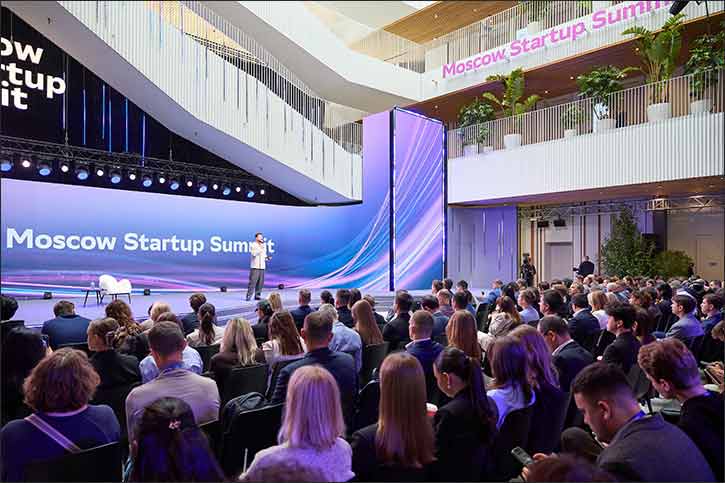
Dubai, UAE, 6th October 2025 : A new study by the Moscow Innovation Cluster, unveiled at the Moscow Startup Summit organized by the Government of Moscow and Sber, challenges widespread perceptions about the startup environment. Experts compared international data on failed companies with their own analysis of promising Russian ventures. The findings dispel key myths and offer a more accurate picture of startup survival rates in Russia and worldwide.
What’s happening?
Globally, there is a shift in how risks for new businesses are assessed. The “Valley of Death” is no longer seen only as a threat, but as an inevitable and in many ways useful stage in strengthening a company. The Cluster’s research shows that success depends less on the size of initial funding and more on the team’s ability to listen to the market, adapt quickly, and make effective use of external support. Despite existing challenges, Russia is developing a resilient and diversified ecosystem where three-year survival rates are comparable to those in Europe and the U.S.
The myth of 90%.
The claim that 90% of Russian startups collapse in their first year is outdated. Studies from the 2010s showed such numbers, but they mainly tracked internet startups and often counted companies that simply stopped growing, not just those that shut down. Current global data suggests that 40–60% of companies close within their first few years with variations by country, industry, and support conditions. The main reason is not funding shortages, but lack of demand and poor market assessment. Other factors include:
- No demand
- Insufficient financing
- Weak team
- Losing out to competitors
- Poor timing of product launch
- Ignoring customer feedback
- Unclear product design
- Ineffective marketing
- Pricing errors or high costs
Who survives?
About 80% of Russian startups face the early-stage crisis. The critical point comes during first sales (41% of cases) or product testing (34%). Survival depends on a comprehensive approach, not just cutting costs. According to the survey, 88% of startups sought external support to get through difficulties. Half did so at the first sign of trouble, 33% only after realizing they couldn’t cope alone, and 11% needed strong advice to take that step.
The key supporters for Russian startups include:
- Major clients and partners (who ease obligations and help improve products)
- Development institutions (as a central source of structured support)
- Incubators and accelerators (mentoring, networking, promotion, product testing)
- Business angels (financial backing)
Yet the research stresses: external help works only when combined with internal strength - a solid team, good management, and fast decision-making.
The Russian specifics.
In Russia, about 61% of tech companies remain on the market after three years — higher than the global average. Startups founded during or after the pandemic proved even more resilient, as they were built in conditions of uncertainty and focused on promising niches from the start.
Bottom line.
The Moscow Innovation Cluster’s study paints a more complex but also more optimistic picture than the usual narrative. The “Valley of Death” is not a death sentence but a tough training ground. Companies that pass through it emerge stronger and more sustainable. The key to success lies in three elements: understanding customer needs, building a strong team, and making full use of the national ecosystem. Russian startups are showing that this formula works.



- H.H. Sheikh Ammar bin Humaid Al Nuaimi chairs Ajman Bank Board Meeting... [1712-Views]
- Five ways Emirates is helping customers travel with greater confidence... [1666-Views]
- Spain Defeats Argentina to Claim Second FIFA World Cup Title... [1663-Views]
- MS Dhoni Joins Malabar Gold & Diamonds as Brand Ambassador, Strengthening the ... [1275-Views]
- Dubai celebrates residents as destination's most powerful advocates through ne... [1165-Views]
- UAE International Investment Council Holds Second Board Meeting, Appointing Ke... [1153-Views]
- The Festival of Diamonds Returns: Tanishq Unveils Over 10,000 Natural Diamond ... [956-Views]
- Dubai's off-plan market raises the bar for next-generation landmark luxury dev... [947-Views]
- Fertiglobe More Than Doubles Adjusted EBITDA in Q2 2026, Proposes H1 2026 Divi... [936-Views]
- 10th Al Dhaid Date Festival draws large crowds, celebrating the UAE's rich agr... [889-Views]
- e& UAE activates the highest 5.5G modulation (1024QAM) on its live network — a... [881-Views]
- Record Profits Driven by Resilience, Sustainable Growth and a Fortress Balance... [868-Views]
- A Benchmark of Trust: The UAE Good Delivery List and the Standard Emirates Gol... [860-Views]
- e& UAE leads industry transition to 5G-native IoT with successful testing of R... [860-Views]
- How to Choose the Right Medical Insurance in Dubai Based On Your Lifestyle?... [858-Views]
- UAE scoops nine medals on opening day of Jiu-Jitsu Asian Championship in Kazak... [848-Views]
- Al Masaood Automobiles Achieves Highest-Ever Score in Nissan's Global Dealersh... [836-Views]
- Al Masaood CVE Set to Go to UD Trucks Extra Mile Challenge Global Finale in Ja... [828-Views]
- e& Successfully Completes Sale of Vodafone Stake, Realizing Cash Proceeds of U... [812-Views]
- UAE National Team steps up preparations for Jiu-Jitsu World Championship in Ab... [785-Views]
