
Emirates Flight Catering (EKFC) commissions large-scale biodigester, with aim to reduce annual CO₂ emissions by 2,000 tonnes
Last Update: Thursday, February 5, 2026 : 13:40 (+4GMT)
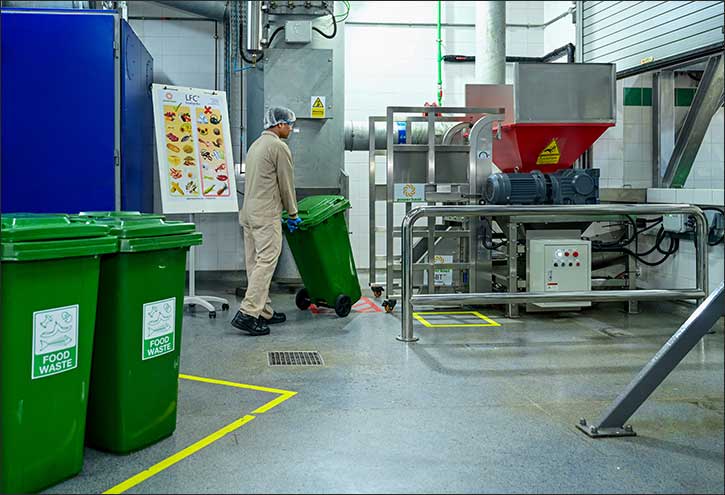
Custom-built system marks significant step in EKFC’s landfill diversion efforts
Dubai, UAE, 5 February 2026 – Emirates Flight Catering (EKFC) is scaling up its approach to waste management with a custom-built biodigester, one of the largest in commercial scale and capacity. The Power Knot LFC-3000 biodigester at EKFC's Central Commissary Unit enables on-site processing of organic waste, treating it at the source rather than diverting it to landfill.
A biodigester functions through aerobic digestion, using oxygen, heat and microorganisms to break down organic waste. This natural process produces grey water which can be repurposed for non-potable use. Unlike mechanical systems that degrade over time, the biodigester becomes more efficient as its microbial culture matures and adapts to a wider variety of feedstock.
Shahreyar Nawabi, Chief Executive Officer of Emirates Flight Catering said: “At EKFC, when we look at where we can make the greatest difference, it's in how we handle waste by treating it responsibly, diverting it from landfill, and finding ways to put it back into productive use. Commissioning a biodigester of this scale is a major operational milestone for us as we accelerate EKFC’s landfill diversion efforts. The strong cross-functional collaboration from every part of the business, in addition to consistent waste segregation efforts of teams on the ground were also key drivers of this project’s successful delivery. The combination of innovation and operational commitment will continue to drive our progress on sustainability."
Since commissioning in December 2025, throughput has risen steadily, with the system now processing an average of up to 3.5 tonnes of waste per day. Current projections for the biodigester at EKFC estimate capacity will increase to around 6 tonnes of food waste per day. *
Using the UK’s Department for Environment, Food & Rural Affairs (DEFRA) aligned GHG conversion factors, EKFC estimates that diverting one tonne of food waste from landfill avoids approximately 0.7 tCO₂e per tonne, primarily by preventing methane emissions stemming from decomposition in landfill. At full capacity and biological maturity, the biodigester could avoid more than 2,000 tonnes of CO₂e annually.
The biodigester is one component of EKFC’s broader efforts to embed sustainability into day-to-day operations. EKFC is advancing strategic investments in energy and fleet, including incorporating solar panels which generated 4,000 MWh last year, avoiding 1,600 tonnes of CO₂e. Electric vehicles are being introduced across operations, and a proof-of-concept electric hi-loader, the first in the region, is expected by mid-2026.
On waste and circularity, EKFC processed nearly 75,000 kg of food waste through its first LFC-50 biodigester last year and eliminated 45,000 kg of plastic annually through packaging changes. It has also developed 47 recipes using production trimmings to repurpose potential waste, while pesticide-free lettuce from Bustanica was used for 28,000 Emirates salads daily last year. AI-driven automation and smart camera technology further support production quality and waste reduction.




- Fresh Skin, Glazed Brows: Benefit Cosmetics Has Your Spring Beauty Mood Covere... [2993-Views]
- Beauty Spring Cleaning with Benefit Cosmetics!... [2355-Views]
- EU261 Reform Misses the Mark on Delays and Competitiveness... [1661-Views]
- Bridal Season Is Officialy Open with Benefit Cosmetics!... [1354-Views]
- Malabar Gold & Diamonds continues its expansion in North America: Launches 8th... [1334-Views]
- UAE Participates in EBRD Board of Governors Meeting and Reaffirms Support for ... [1329-Views]
- Dubai Summer Surprises 2026 Unveils an Action-Packed Calendar of Shopping, Din... [1252-Views]
- Riyadh Air Opens Ticket Sales for Daily Service between Dubai, UAE and Riyadh,... [1115-Views]
- Ministry of Finance Unveils UAE's First Sovereign Retail T- Sukuk Investment O... [1101-Views]
- Sports Coordination Council discusses sports representation framework, governa... [1096-Views]
- Under the directives of Mohammed bin Rashid Dubai Humanitarian facilitates se... [1051-Views]
- ãÌãæÚÉ ÇáÎáíÌ áÇÓÊÑÌÇÚ ÇáÃãæÇá ÇÓÊÑÏÇÏ ÎÓÇÆÑ ÇáÊÏÇæá ÈÎÈÑÉ ... [1050-Views]
- UAEREP Kicks Off AI-Driven Research Project on Next-Generation Cloud Seeding M... [1034-Views]
- Umm Al Quwain Free Trade Zone (UAQ FTZ) Launches Company Migration Programme t... [1003-Views]
- Mohammed Bin Rashid Library Emphasises Role of Families in Building Children's... [953-Views]
- Under supervision of Smart and Autonomous Systems Council, Abu Dhabi Investmen... [944-Views]
- UAE Pavilion Highlights Defence Innovations as Eurosatory 2026 Nears Final Day... [874-Views]
- Arsenal Legend Robert Pirés Visits TCL Air Conditioner Smart Manufacturing Bas... [865-Views]
- North Gate British School Launches Green Sadaqah: Forest Beyond Borders... [847-Views]
- The Launch of EDGE Europe: EDGE Heralds a New Model for European Defence... [840-Views]
