
Astrophysicists Measure Precise Rotation Pattern of Sun-like Stars for the First Time
Last Update: Saturday, September 22, 2018 : 09:24 (+4GMT)
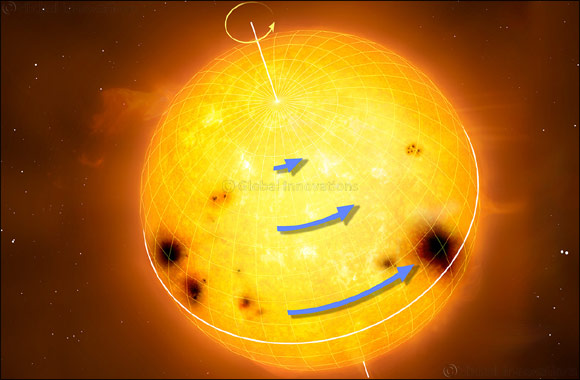
Equators of Sun-like stars rotate up to two and a half times as fast as higher latitudes, NYU Abu Dhabi researchers have discovered
Fast Facts
- Scientists measure differential rotation on Sun-like stars for the first time
- Sun-like stars rotate up to two and a half times faster at the equator than at mid- to high-latitudes, a finding that challenges current science on how stars rotate
- Studying how stars spin can provide insights into how stars, including the sun, generate magnetic activity
Abu Dhabi, September 22, 2018: Sun-like stars rotate up to two and a half times faster at the equator than at higher latitudes, a finding by researchers at NYU Abu Dhabi that challenges current science on how stars rotate.
Until now, little was known about the precise rotational patterns of Sun-like stars, only that the equator spins faster than at higher latitudes, similar to the Sun.
Scientists at the NYU Abu Dhabi Center for Space Science used observations from NASA’s Kepler mission and asteroseismology — the study of sound waves traveling inside stars — to determine with precision how Sun-like stars rotate, which no other scientific method has been able to achieve.
Their study found that Sun-like stars, characterized as being like the Sun in mass and age, do indeed rotate in a similar manner as the Sun in that their equatorial regions rotate more rapidly than at mid- to high latitudes. But there’s a key difference.
The equator of the Sun rotates about 10 percent faster than its mid latitudes, while equators of Sun-like stars spin up to two and a half times faster than their mid latitudes.
“This is very unexpected, and challenges current numerical simulations, which suggest that stars like these should not be able to sustain differential rotation of this magnitude,” said Othman Benomar, research associate at the NYU Abu Dhabi Center for Space Science and lead author of the study published in Science Magazine.
“Understanding differential rotation — how fast one part of a star spins compared to the rest — is not only important for a complete understanding of how a star works, it will help us gain deeper insights about their magnetic fields,” explained Katepalli Sreenivasan, principal investigator of the NYU Abu Dhabi Center for Space Science.
Magnetic fields on the Sun have been known to cause enormous solar storms that frequently disrupt orbiting space satellites and have knocked out power grids on Earth.
Scientists agree that the rotation of the Sun plays a crucial role in the generation of the solar magnetic field, but the exact details still remain a mystery, despite the Sun having been observed and studied in great detail.
Sreenivasan added, “learning more about how stars rotate and generate their own magnetic fields could help us gain further insight into the solar dynamo, the physical process that generates the Sun’s magnetic field.”
The NYUAD Center for Space Science is supported by the NYUAD Research Institute, which promotes cutting-edge and innovative research through the support of its 12 centers, labs, and projects.
Additional facts
Asteroseismology
Allows scientists to determine precisely how a star rotates by measuring frequencies of acoustic waves inside the star. Helioseismology is used on the Sun for the same purpose.
Differential rotation
Rotation speeds on the Sun and stars vary at different latitudes because they are fluid (the middle spins faster than the poles). By contrast, a spinning basketball has rigid rotation — it spins at the same speed from top to bottom.
Previous Article
Henley & Partners welcomes new Citizenship-by-Investment Program ...
Next Article
Kalyan Silks Flood relief
Related Articles More Local & Government News ›






Most Viewed – Last 30 Days
- Five ways Emirates is helping customers travel with greater confidence... [2070-Views]
- Sheikh Zayed Falcon Release Programme releases 2,400+ falcons in the wild sinc... [1604-Views]
- From a Pair of Shoes to a New Dubai Property: British Expat Wins Through ‘Win ... [1604-Views]
- e& UAE launches Business Pro AI bundled with Microsoft Copilot at no additiona... [1162-Views]
- e& UAE leads industry transition to 5G-native IoT with successful testing of R... [1080-Views]
- How to Choose the Right Medical Insurance in Dubai Based On Your Lifestyle?... [1021-Views]
- Held under the patronage of His Highness Sheikh Hamdan bin Zayed Al Nahyan Ab... [969-Views]
- Tadej Pogacar Chases Tour de France–Vuelta a Espana Double... [928-Views]
- Beautyworld Dubai's 30th Edition Brings Global BeautyIcons Together This Octob... [920-Views]
- Qualcomm Announces Third Quarter Fiscal 2026 Results... [807-Views]
- To enhance quality of sports services Ministry of Sports organises the first ... [796-Views]
- Dubai Summer Surprises Launches First Back-To-School Carnival at Palm Jumeirah... [790-Views]
- e& reports 11.6% increase in consolidated revenue to AED 38.1 billion in H1 20... [774-Views]
- The Fellowship Just Got a Glam Upgrade with SHEGLAM X The Lord of the Rings™... [735-Views]
- Danube Properties Announces Handover of 11 Projects In Dubai Over Next 12 Mont... [733-Views]
- Dubai Summer Surprises to reward 10 lucky shoppers with Modesh Scholarships wo... [728-Views]
- LG EMPOWERS DESIGNERS AND VIDEOGRAPHERS WITH NEW ULTRAFINE EVO 6K MONITOR... [718-Views]
- DSS FINAL SALE BRINGS UP TO 90% OFF ACROSS MORE THAN 500 BRANDS FOR THE FINAL ... [707-Views]
- RTA Hosts Microsoft Copilot Day to Enhance Employee Efficiency and Accelerate ... [682-Views]
- Unexpected Blessing: Long-Time Dubai Resident Becomes the Sixth Winner of 'Win... [676-Views]
