
Emirates Foundation Think Science Ambassadors Shine at 6th Intel's Science Competition Arab World in Egypt
Last Update: Sunday, December 20, 2015 : 18:11 (+4GMT)
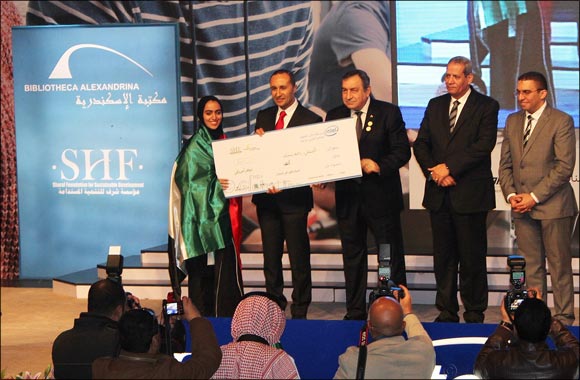
UAE Youth Innovative Projects in Environmental Engineering & Physical Energy Win Three of Intel’s Prestigious Awards
Abu Dhabi, December 20, 2015 – Two teams of young female innovators from the UAE, who are part of Emirates Foundation Think Science Ambassador programme, won three awards at the Intel’s Science Competition Arab World in Egypt that took place in Alexandria from December 17-19, 2015.
The winning teams were part of 15 Emirati youth selected to take part in the prestigious competition, as part of their commitment to nurture science and technology among youth in the UAE. The Emirati talents who took part and won in the prestigious competition were nominated in light of their recent participation in the 2015 Think Science national competition.
Think Science Ambassadors project is one of the Emirates Foundation leading programmes which was set up in partnership with the UAE Minister of Education and Abu Dhabi Education council. The programme aims to spark Emirati youth’s interest in science and technology (S&T) with a view to encouraging them to both study science and technology and follow a career in this area
The UAE Think Science Ambassadors competed against more than 130 students from 11 Arab countries across the Middle East and North Africa and presented seven innovative ‘Made in the UAE’ STEM projects in areas aligned with the UAE’s Vision 2021, including thermo-electric smart buildings, IT security, bio-mass energy from banana peels, nano-technology for wastewater management, solar-driven plastic reuse for energy, smart home power service device and mechanical neo-natal ventilators.
An elite panel of judges awarded the two winning projects from the UAE who won a total of three prizes. The first project, presented by Maryam Mohammad Al Hashmi which she worked on with her partner Marwa Yusuf Mohamed, from Al Ittihad Private School – Jumeirah, Dubai, that uses solar energy to recycle plastic to build a cheap, efficient and eco-friendly modules that can be used as a source of natural lighting and an alternative to electric light, won the second grand prize of all categories, and the first place in environmental engineering. The second project, presented by Noora Hamad Almarri, from Dubai National School, which uses thermoelectric sources of energy for smart buildings, won first place in the category of physical energy.
“It’s at the heart of Emirates Foundation’s mission to inspire the UAE youth to take vested interest in Science, Technology, Engineering and Maths (STEM) and to pursue their passion for innovation,” said Clare Woodcraft-Scott, CEO of Emirates Foundation. “Through our Think Science program, we have made long strides towards this goal, with the help of our long-standing partners from the private and public sectors, especially the Ministry of Education and Abu Dhabi Education Council. “At the same time, we are working to foster youth’s talent in science through international competitions such as Intel Science Competition Arab World as we strive to build a sustainable pipeline of science-oriented minds who can fill the mounting demand in the market,” she added.
Maytha Al Habsi, Emirates Foundation’s Chief Programs Officer said Think Science was created in response to a yawning gap in the market for young Emirati graduates of STEM disciplines. “A downturn in the number of youth studying STEM prompted us to look into the best way to promote interest for STEM among both students and academic institutions. Think Science was one of the programs created to help address this need.” “And today, we are proud that these young scientists are carrying the UAE’s name high at an international science competition by a global IT leader - Intel.”
Maryam Mohammad Al Hashmi, one of the winning Science Ambassadors said, ”It was an amazing experience for us to participate and win in Intel Arab World.
We cannot thank Emirates Foundation enough for this rewarding opportunity. It is not about winning as much as the exposure, experience and learning we got out of it.”
Intel Arab World Science Competition aims to encourage talented students aged between 14-18 years to showcase their talents and their innovative insights in scientific research and execute scientific projects based on the methodology and tenets of scientific research. The contest, held in association with Sharaf Foundation and the Bibliotheca Alexandrina (BA), attracted over 130 young science participants from 11 Arab countries, who proudly presented their innovative projects to be judged by a group of leading and highly reputable jurors.
Think Science Ambassadors Projects
Noora Hamad Almarri, from Dubai National School - Al Twar, presented a model of a house, which will have an air conditioner and electric lights powered by thermoelectric energy. Thermoelectric energy is the result of the difference between the cold temperature inside the house and the hot temperature outside. The difference in temperatures creates electricity that provides alternative solutions for a world that mostly relies on electricity. Based on the thermoelectric effect, thermoelectricity can provide power in houses all around the country.
A team of Ghareibah Mohamed Al Yammahi, Sendeyah Hasan Al Yammahi, and Ahoud Rashed Al Yammahi, from Al Tawyeen School, presented a “secret screen”: a computer screen that can only be seen through special eyewear to ensure the security and privacy of what is displayed on the screen.
Latifa Hamdan Al Shamsi and Aysha Abdulla Alneyadi, from the Applied Technology High School of Al Ain, presented what they called Banana Peel Biomass Briquettes.
Banana peels are gathered and compressed into biomass briquettes biofuels that are better alternatives to fossil fuels, like coal and charcoal, as they produce low net total greenhouse gas emissions. Biomass briquettes are mostly used in the developing world, where cooking fuels are not as easily available.
Abdul Aziz Tareq Alzarooni, from Al Dhafra Private Schools - Al Ain, demonstrated how magnetic nanoparticles could be chemically functionalized to be used as absorbents for the removal of heavy metal ions pollutants for the treatment of wastewater.
The Epilogue of Plastics, presented by Maryam Mohammad Al Hashmi, from Al Ittihad Private School – Jumeirah, Dubai, is an innovative method of recycling plastics by using plastic bottles with the support of solar energy to transform the bottles into cheap, efficient and eco-friendly modules that can be used as a source of natural lighting and an alternative to electric light.
Talal Abdullah Algumaei and Adel Saeed Alhajeri, from Omar Bin Al Khattab Model School, Dubai, presented the smart home power saver, which detects the presence of a human body through infrared detectors and accordingly the air conditioners settings will be automatically adjusted in order to reduce the consumption of energy.
Mohammad Abdulla Abdulmalek, Saif Yaqoob Al Shamsi, and Khalid Khalid Anwahi, from Dubai Arab American Private School, showcased the mechanical neonatal ventilator, a low cost device that performs the essential duties of an ordinary ventilator in order to save the lives of premature babies and those born with breathing conditions that need these devices to get through their most difficult early weeks. Neonatal ventilators can cost tens of thousands of dollars each, a price that’s out of reach for many impoverished areas of the world.
Commenting on the results of Intel Science Competition Arab World, Clare Woodcraft-Scott said, “We are certainly excited by the impressive performance of our Think Science Ambassadors at this important regional event, which was a great opportunity for Think Science Ambassadors to represent the UAE and compete at a regional level. “
Held under the Patronage of H.H. Sheikh Abdullah bin Zayed Al Nahyan, UAE Foreign Minister and Chairman of the Emirates Foundation, Think Science competition is an annual nationwide contest that engages UAE youth to develop, design and build science-based innovations that respond to society’s most pressing needs.


- From a Pair of Shoes to a New Dubai Property: British Expat Wins Through ‘Win ... [2357-Views]
- Five ways Emirates is helping customers travel with greater confidence... [2094-Views]
- Sheikh Zayed Falcon Release Programme releases 2,400+ falcons in the wild sinc... [1626-Views]
- e& UAE launches Business Pro AI bundled with Microsoft Copilot at no additiona... [1213-Views]
- e& UAE leads industry transition to 5G-native IoT with successful testing of R... [1105-Views]
- DSS FINAL SALE BRINGS UP TO 90% OFF ACROSS MORE THAN 500 BRANDS FOR THE FINAL ... [1090-Views]
- How to Choose the Right Medical Insurance in Dubai Based On Your Lifestyle?... [1044-Views]
- Held under the patronage of His Highness Sheikh Hamdan bin Zayed Al Nahyan Ab... [999-Views]
- Beautyworld Dubai's 30th Edition Brings Global BeautyIcons Together This Octob... [965-Views]
- Tadej Pogacar Chases Tour de France–Vuelta a Espana Double... [950-Views]
- To enhance quality of sports services Ministry of Sports organises the first ... [850-Views]
- Qualcomm Announces Third Quarter Fiscal 2026 Results... [828-Views]
- Dubai Summer Surprises Launches First Back-To-School Carnival at Palm Jumeirah... [820-Views]
- e& reports 11.6% increase in consolidated revenue to AED 38.1 billion in H1 20... [798-Views]
- The Fellowship Just Got a Glam Upgrade with SHEGLAM X The Lord of the Rings™... [766-Views]
- LG EMPOWERS DESIGNERS AND VIDEOGRAPHERS WITH NEW ULTRAFINE EVO 6K MONITOR... [761-Views]
- Dubai Summer Surprises to reward 10 lucky shoppers with Modesh Scholarships wo... [749-Views]
- RTA Hosts Microsoft Copilot Day to Enhance Employee Efficiency and Accelerate ... [703-Views]
- Unexpected Blessing: Long-Time Dubai Resident Becomes the Sixth Winner of 'Win... [701-Views]
- ORA Land Launches BluBay with Suryakumar Yadav as Brand Ambassador, Reinforcin... [684-Views]
