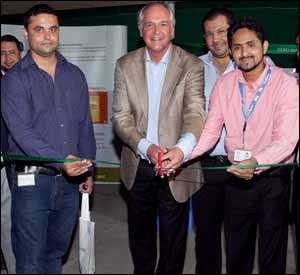
Significant milestone towards achievement of Unilever's long-term goal of halving its environmental footprint Dubai, 27 August 2013: Unilever's Lipton Jebel Ali factory based in Dubai, UAE, has achieved its goal of sending zero waste to landfill. This achievement gives the factory the unique distinction of being the first factory in the Jebel Ali Freezone (JAFZA), and also across the UAE to recycle or reuse all of its waste. This is a significant milestone for the plant, which is Unilever's second largest tea production facility globally, producing an astonishing 1.2 million tea bags per hour to total 6 billion tea bags per year. The factory, which in the past produced up to 450 tonnes or 5.4kg/tonne of waste a year requiring 31,000 sq metres of landfill space, is today generating below 0.09 kg of waste/tonne. This puts it in the zero waste to landfill technical category. This reduction is the equivalent of saving 12,280 trees, and cutting back emissions by 904 tonnes. “Sending zero waste to landfill is key to achieving our Unilever Sustainable Living Plan, which calls for halving our environmental footprint by 2020. This is a great example of how we are putting our sustainability strategy into action, by decoupling the growth of our business from its environmental impact. We have achieved this by applying the four R's of reducing, reusing, recovering and recycling. For instance, tea dust is reused as fertilizers,” said Sanjiv Mehta, Unilever MENA Chairman. As the last step of achieving zero waste to landfill, Unilever Gulf has installed a composting machine to treat the organic waste output. The machine was inaugurated during the recent visit of Paul Polman, Unilever Global CEO, to Dubai. With annualised production volumes increasing from 5000 Tonnes to 25,000 Tonnes in 10 years, this site is today a global tea-sourcing hub exporting to 47 countries worldwide. “By reducing our environmental footprint while promoting business growth, we can ensure that increased product volumes don't come at the expense of the environment. This enables us to sustainably deliver products to improve the consumer's quality of life while actually reducing the waste and emissions in absolute terms,” Mehta added. By end 2012, 130, or over 50 percent of Unilever factories globally, send zero non-hazardous waste to landfill. This is equivalent to removing more than one million household bins of waste every year. Under its Sustainable Living Plan, Unilever announced that by 2020, global waste sent for disposal would be at or below 2008 levels - despite producing significantly higher volumes. Today, Unilever is stretching the original target even further by bringing the 2020 commitment 5 years forward. A total of 252 factories across the world will not send any non-hazardous waste to landfill by end of 2015.
| 

 RSS Feed

